Login
Login

SAP S/4HANA Private Cloud 2025: Key SD, BRIM, and Service Management Innovations
SAP S/4HANA Private Cloud 2025 continues to advance enterprise-grade capabilities for organisations running complex, high-volume processes in multiple industries. For SAP SD consultants specialising in Billing and Revenue Innovation Management (BRIM) or Service Management, this release brings significant enhancements that focus on automation, compliance, financial transparency, and operational efficiency.
SAP S/4HANA Private Cloud
SAP BRIM Contract Accounting (FI-CA)
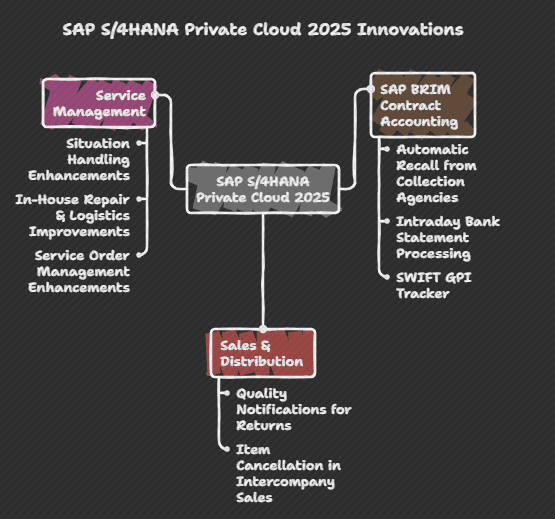
Automatic Recall from Collection Agencies via API
You can now automatically recall collection items when confirmation data arrives via the API Collection Agency – Confirmation. This eliminates manual intervention and enhances sync with external collection agencies.
Intraday Bank Statement Processing
To process intraday bank statements more efficiently, FPB7P-Transfer Run for Bank Statements is now capable of automatically importing bank statements at regular intervals into payment and return lots – only new data being transferred at each interval.
Track Payment Status Globally with SWIFT GPI Tracker
SAP now supports unique End-to-End Transaction Reference (UETR) tracking for outgoing SWIFT payments that use SAP payment formats, providing Treasury teams the ability to monitor payment status globally via SWIFT GPI Tracker.
G/L Item Visibility during Write-Offs
In General Ledger, items simulated and posted for write-offs during single document write-offs are now visible compared with mass write-offs only (FP04M). This increases auditability and financial transparency.
Collection Strategies in Dunning Proposal Runs
Now you can select collection strategies directly when scheduling a dunning proposal run, providing tailored dunning approaches based on customer risk profiles. Consultant tip: Allows for differentiated dunning approaches explicitly tailored for customers.
Payment Card Token Storage in Provider Contracts
Contract items can now refer to stored business partner payment cards or one-time cards issued through SAP Digital Payments (token-based), both of which can be managed using SOAP APIs or BAPIs.
Impact: Secure and flexible card payment processing for subscription and usage-based billing is achieved.
Reversing Documents with Direct G/L Updates
Now, Possible Documents posted with direct G/L updates can be reversed with direct G/L transfers using the Reverse Documents App, providing cleaner reversals and reduced reconciliation effort.
Contract Master Data in BP Financial Overview App
The Business Partner Financial Overview (F2429) app now displays contract master data, providing finance and collections teams with single-pane visibility of their contracts.
Divergent Invoicing
Billing document items can now be designated either print-relevant or posting-relevant independently, with costs postings being left off of customer invoices while still being posted to finance. As an example: Cost postings may be left off customer invoices while still being posted to finance.
Outcome: Cleaner invoices that meet customer demands without accounting compromises.
Subscription Order Management (SOM)
Change Usage-Based Scenarios:
You can now modify SAP Convergent Charging parameters and cross-catalog mapping versions through Solution Quotations (A2X)*SOM OData APIs. Use case: Flexible tariff updates.
Insights Cards for SOM Apps
Insights Cards provide summarised and contextual business data directly within SOM Apps for faster decision-making without needing to navigate multiple reports. Their value lies in faster decision-making without needing to navigate multiple reports first.
Master Agreements Now Support Target Quantities
Now available are master agreements which support target quantities as well as released quantities; this allows partial releases through call-off documents, making them ideal for framework agreements or phased consumption models.
SAP Convergent Charging now supports the rerating of shared allowances with strict validation rules for this feature. All products within a subscription must support rerating uniformly to ensure an equitable experience.
Subscriptions with Recurring Physical Deliveries
Now subscriptions can also include the delivery of physical goods modeled by bundles or BOMs. Sales orders are automatically created based on delivery plans; industry applications may include utilities, consumables and equipment-as-a-service offerings.
Sales & Distribution
Quality Notifications for Returns
Now when placing returns orders, automatic quality notifications can now be created when saving them automatically, creating closed-loop quality management with SD + QM integration.
Item Cancellation in Advanced Intercompany Sales
Items can be deleted from sales orders in advanced intercompany and valuated stock-in-transit scenarios without creating delivery. This flexibility reduces rework in complex supply chains.
Service Management in S/4HANA 2025
New Situation Handling Enhancements ,These situation templates notify service managers about:
- Trade Compliance Blocks
- Logistics Inconsistencies
- Stock Inconsistencies
Outcome: Proactive Issue Resolution.
Key Enhancements to In-House Repair & Logistics Improvements
These improvements include:
- Transferring service objects between service centers
- Posting service objects directly to customer stocks.
- Inbound delivery-based receipt of service objects Flexible plant and storage location determination This results in stronger logistics integration during service execution.
Enhancements to Service Order Management
Highlights For these enhancements:
- Rejection profiles with predefined reasons
- Harmonized Document Management (HDM) for attachments
- One-Click Release Button for Service Orders And Facieted overview pages
- Intercompany service hierarchy with collective accounting
- Planned cost and revenue allocation for unplanned items
- Multiple revenue accounts for POC scenarios Tool items to handle billing and internal cost allocation
- Editable output control fields for profit center reorganization.
- Automated and redeterminable plant/storage location
Finance + Service Align: Increased Revenue Recognizance and Margin Tracking.
Conclusion
SAP S/4HANA Private Cloud 2025 offers practical, consultant-driven enhancements across SD, BRIM, Subscription Management and Service Operations. Its focus lies on automation, transparency, flexibility and tighter integration among finance, sales and service departments. SAP SD-BRIM-CS consultants know this release goes beyond technical advances; it directly enhances business outcomes.
- introduction sap btp for consultants
- sap consultants productivity with joule
- Migration guide to sap data migration
- SAP btp guide to app development
- Transformation journey 4hana implementation
- empowering enterprises with sap solutions
- blackline tool vs traditional process
- Sap cutover plan a comprehensive guide
- fiori configuration guide
- SAP ecc to s4hana data migration
- earn sap btp
- Retail insights with sap car
- leanix an introductory guide
- building side by side extensions on sap btp
- sap ecc vs s4 hana key changes and benefits
- sap ides
- Understanding rfno in sap s4hana
- SAP Clean Core
- SAP ABAP begnner’s journey
- Grow with sap vs rise with sap comparison
- Rise with sap
- Year-end activities in sap
- SAP TM Transaction codes
- ethical ai development
- sap migration data configuration tools
- simplifying sap s4hana custom code migration
- sap ewm integration
- sap project intelligence network
- advanced production integration with sap ewm
- Credit management comparison of sap fscm
- SAP EWM
- sap s4hana migration
- GST E invoice
- understanding abap objects
- SAP interfaces
- Joule ai copilot
- Mastering sap background job processing
- SAP Ewm tcodes a handy guide
- Object-oriented programming in sap abap
- understanding sap license costs
- SAP Datasphere
- industry4.0 with sap
- Condition contract management in sap s4 hana
- Comprehensive guide to go live
- SAP EHS Module
- Power of generative ai in sap
- SAP Joule Comprehensive Guide
- Mastering the dunning process sap
- Creation of chart of accounts in sap fico
- Different roles of an sap consultant
- understanding sap system landscape
- Product costing in sap
- Copa in sap
- subcontracting process in sap mm
- SAP S4hana cloud
- Disaster Recovery in SAP HANA Cloud